
For all workers, Qatar introduced a non-discriminatory minimum wage in March 2021. It consists of a base wage of QAR 1,000, plus mandatory housing payments of QAR 500 and food payments of QAR 300, creating a total minimum package of QAR 1,800, ensuring fair pay and stability in the labor market. Qatar’s Wage Protection System (WPS) enforces this reform as part of broader labor law changes, including the dismantling of the Kafala system, making Qatar a more attractive global talent destination
What is The Meaning of Minimum Wage?
A minimum wage represents the basic salary below which labour or services cannot be sold by an employer legally. A minimum wage law is implemented in most countries in order to protect workers.
To improve worker living standards and support their families, the Qatari government introduced a minimum wage law in August 2020. A more skilled and productive workforce is also a goal of the policy.
A detailed guide to the minimum wage in Qatar is provided in this article, along with answers to frequently asked questions.
Who Is Covered Under Qatar’s Minimum Wage Law?
According to Law No. 17 of 2020, Qatar’s minimum wage applies to all private-sector workers, including domestic workers, regardless of nationality, with a basic monthly salary of QAR 1,000 as well as mandatory allowances for food (QAR 300) and housing (QAR 500), totaling QAR 1,800 per month.
How Much is the Minimum Wage in Qatar?
No. 17 of 2020 establishes a minimum wage of QAR 1,000 per month as a basic wage for all private sector workers in Qatar, including domestic workers, as well as 500 QAR for accommodation expenses and 300 QAR for food, unless the employer already provides adequate food or accommodation for the employee or domestic worker.
An employer can either provide food and accommodation or pay more so employees can arrange their own.
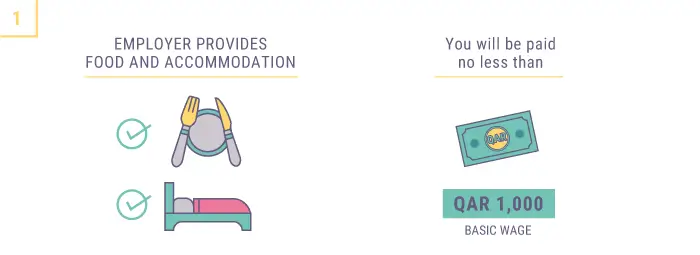
Qatar’s minimum wage has three different rates, assuming you are an employee:
Step 1: If your employer provides decent food and lodging (i.e., you do not pay for food and lodging), you are entitled to a minimum wage of QAR 1,000.
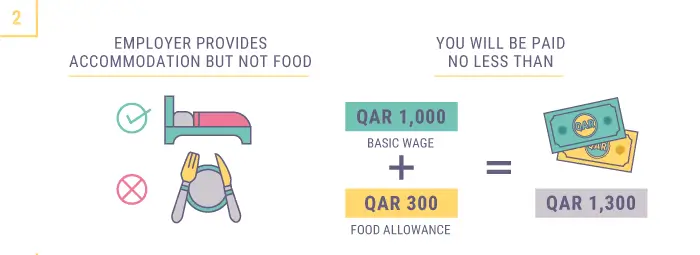
Step 2: If your employer provides decent housing, but not food, you are entitled to a food allowance of at least QAR 300 in addition to your basic wage. In this case, you should receive at least QAR 1,300 per month.
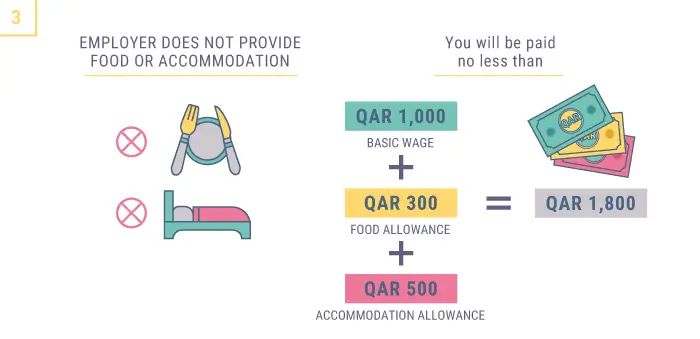
Step 3: The employer must provide you with accommodations and food, and you must receive no less than 300 QAR per week for food and 500 QAR per week for accommodation, in addition to your basic wage. Your monthly salary should be at least 1,800 QAR in this case.
What Is Included in the Minimum Wage?
Generally, the minimum wage includes your basic pay and certain add-ons like shift premiums, bonuses, and commissions, but excludes overtime and tips (though some countries do count tips). Qatar’s minimum wage covers all workers with a base salary (QAR 1,000) plus allowances for food (QAR 300+) and housing (QAR 500+). In most countries, it’s about total earnings for normal hours, ensuring a wage floor for most workers, though some (such as youth or domestic workers) might have different rules.
What to Do If You Are Paid Less Than the Minimum Wage
- Collect proof such as pay slips, bank statements, and your employment contract.
- Talk calmly with your employer and explain that you are being paid below the minimum wage. Show your calculations clearly.
- If the issue is not fixed, formally ask your employer for payment records and wage details.
- If the problem continues, file a complaint with the local labour authority so they can investigate and help you recover your unpaid wages.
Impact of Minimum Wage on Workers and Employers
A minimum wage increase can lead to an increase in wages for low-wage workers, reducing poverty and inequality, but it can also cause employers to cut jobs, reduce hours, slow hiring, or replace labor with capital. The effects differ depending on the economic conditions and the minimum wage level, but many studies find minimal job losses, especially for young, unskilled workers and small businesses.
For Workers
| Pros | Cons |
|---|---|
| Higher income for low-paid workers | Fewer entry-level job opportunities |
| Improved living standards | Harder for young or inexperienced workers to find jobs |
| Stronger bargaining power | Reduced on-the-job training opportunities |
| Better financial stability | Limited chances for long-term skill development |
For Employers
| Pros | Cons |
|---|---|
| Lower staff turnover and better productivity | Higher labour costs increase expenses |
| Improved employee morale and attendance | Profit margins may shrink, especially for small businesses |
| More stable workforce | Employers may reduce hiring or cut working hours |
| Better work performance | Some jobs may be automated or prices increased |
| — | Employment impact can be mixed and hard to predict |
FAQS About Minimum Wage in Qatar
What is the minimum wage in Qatar?
Qatar’s minimum wage is QAR 1,000 basic salary, plus QAR 500 for housing and QAR 300 for food, making a total minimum package of QAR 1,800 per month.
Who is covered under Qatar’s minimum wage law?
The minimum wage applies to all private-sector workers, including domestic workers, regardless of nationality.
Can employers provide food and accommodation instead of cash?
Yes. Employers can either provide decent food and housing or pay the required allowances so employees can arrange their own.
What should I do if I am paid less than the minimum wage?
First, talk to your employer with proof like payslips. If the issue continues, you can file a complaint with the labour authorities.
How is the minimum wage enforced in Qatar?
Qatar uses the Wage Protection System (WPS) to ensure salaries are paid correctly and on time under labour law.
Conclusion
Qatar’s minimum wage ensures fair pay for all private-sector and domestic workers through a basic salary and mandatory allowances. Backed by the Wage Protection System, it improves living standards, strengthens worker rights, and promotes labour market stability. Understanding these rules helps employees protect their income and enables employers to stay compliant with Qatar’s labour laws.