

Qatar traffic signs play a vital role in maintaining road safety and smooth traffic flow across the country. These standardized symbols provide clear instructions and warnings that help drivers, pedestrians, and cyclists understand how to behave on the road. Ignoring or misinterpreting traffic signs can lead to accidents, fines, and penalties under MOI traffic laws. Qatar’s road signs are displayed in both Arabic and English, though some appear only in Arabic, making familiarity essential for all drivers. Understanding the purpose of regulatory, warning, and informational signs not only helps drivers pass the driving test but also promotes responsible and confident driving in everyday life.
Understanding Traffic Signs in Qatar
Before examining specific examples, it’s important for drivers to be familiar with the basic conventions that determine the meaning of traffic signs:
- Symbols/Text: Signs often feature bilingual legends in Arabic and English to ensure clarity for both residents and visitors.
- Shape: Circles indicate regulations, triangles signal warnings, and rectangles convey information.
- Color: Red denotes prohibitions, blue indicates mandatory actions, yellow or orange warns of caution, and green or brown provides directions or destination information.
What Are Qatar Traffic Signs in Qatar?
Qatar traffic signs are official road indicators designed to guide and regulate road users for safe and organized travel. Displayed in distinct shapes, colors, and symbols, these signs provide clear instructions such as when to stop, slow down, yield, or change direction. Placed strategically along roads and intersections, they help manage traffic flow, reduce accidents, and ensure that drivers, pedestrians, and cyclists follow MOI traffic regulations for a smooth and secure journey.
Types of Qatar Traffic Signs
- Regulatory (Mandatory) Signs
- Warning Signs
- Informational Signs
- Directional and Guide Signs
- Temporary and Roadwork Signs
1: Regulatory (Mandatory) Signs
Regulatory signs in Qatar are legally enforceable traffic signs that drivers must follow at all times. These signs control road behavior by indicating restrictions, obligations, and prohibitions to ensure safety and order on the roads. Failure to obey these signs can result in fines or traffic penalties under MOI regulations.
- Stop Sign: Drivers are required to stop completely before proceeding.
- Give Way/Yield Sign: Drivers must give priority to other vehicles.
- Speed Limit Sign: Indicates the highest speed permitted on the road.
- No Parking/No Stopping: Prohibits parking or stopping to ensure smooth traffic flow.
- No Entry: Prevents vehicles from accessing restricted roads.

2: Warning Signs
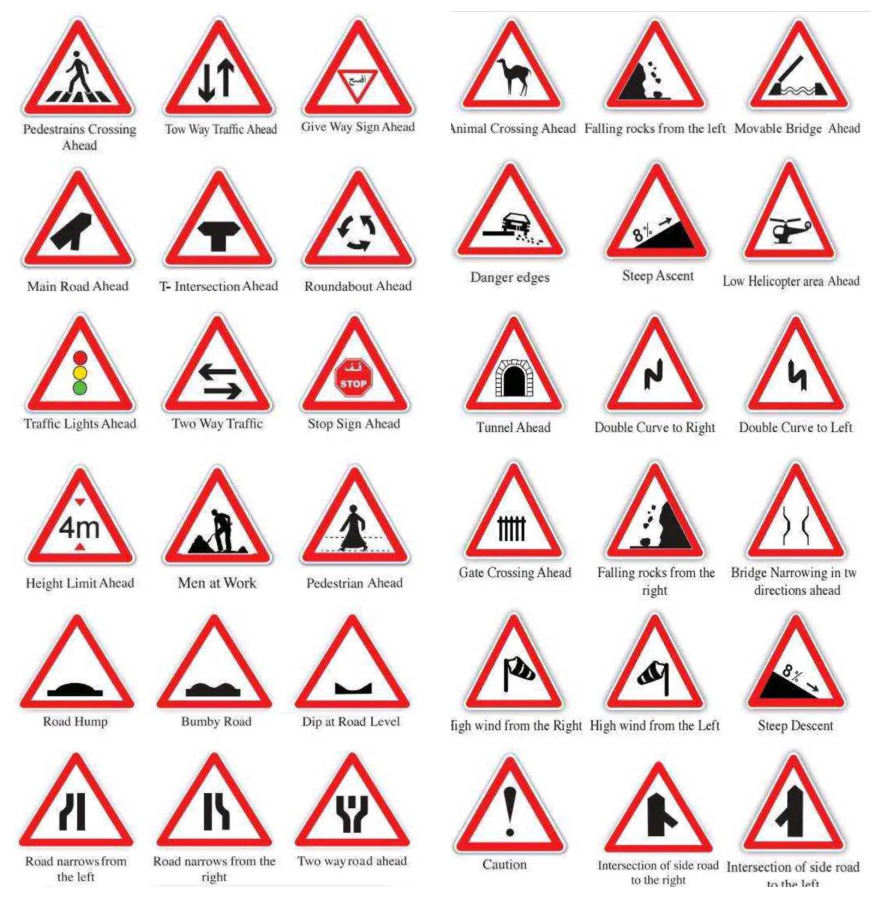
These signs are used to alert road users to potential hazards and help them take necessary precautions in advance. In Qatar, warning signs are designed in the shape of an equilateral triangle with the base at the bottom and the point facing upward. They feature a red border, a white background, and black symbols. The following are the warning signs used in Qatar.
- Sharp Turn Ahead: Informs drivers to slow down and prepare for a bend.
- Pedestrian Crossing: Indicates a crossing area where pedestrians have priority.
- Roadwork Ahead: Warns of ongoing construction or maintenance work.
- Camel Crossing: Common in desert regions, cautioning drivers about animals crossing.
- Slippery Road: Alerts drivers to reduced road grip, especially during wet conditions.
3: Informational Signs
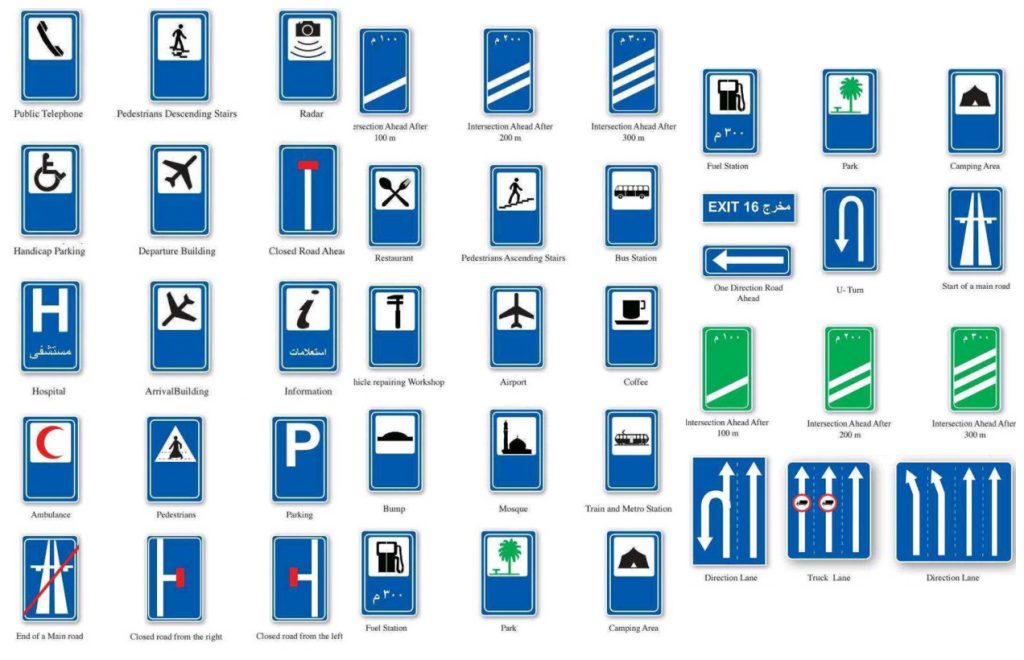
Informational signs in Qatar are designed to guide road users by providing clear directions, service locations, and essential road information. These include rectangular signs indicating destinations and facilities such as hospitals, airports, towns, parking areas, and rest stops. Qatar’s road network also features warning signs with red borders that alert drivers to conditions like sharp bends, school crossings, slippery roads, and roundabouts, along with regulatory signs such as speed limits and no-parking instructions. In addition, intelligent road signage is increasingly used to deliver real-time updates, supporting safe navigation, traffic compliance, and efficient movement across the country’s modern infrastructure.
4: Directional and Guide Signs
These signs are metal or electronic displays designed to assist and guide road users. They provide essential information about directions, destinations, lanes, services, and other helpful details. Informational signs in Qatar are typically rectangular or square in shape, with backgrounds in blue, green, brown, or white. The following are some of the most commonly used informatory road signs in Qatar:
- Highway Exit Signs: Indicate approaching exits on expressways and highways.
- Hospital Signs: Show the location of nearby medical facilities.
- Petrol Station Signs: Guide drivers to fuel stations.
- Tourist Destination Signs: Point out historical, cultural, and tourist attractions.
- Street Name Signs: Identify roads and streets within cities and residential areas.
5: Temporary and Roadwork Signs
In Qatar, temporary and roadwork signs are usually orange or yellow with prominent black symbols, highlighting short-term changes such as lane closures, diversions, or reduced speed limits. These signs may be accompanied by flashing lights, traffic cones, or flag personnel to manage traffic. Drivers are expected to slow down and follow instructions carefully to ensure safety around construction zones, especially in rapidly developing areas like Lusail and Al Wakrah.
Examples of Temporary Signs in Qatar:
- Detour Sign: Directs traffic along an alternate route.
- Lane Closure: Alerts drivers to lanes that are temporarily closed.
- Road Closed: Blocks access to certain roads for safety reasons.
- Men at Work: Warns drivers of construction or maintenance activities on the road.

6: Prohibition Signs in Qatar
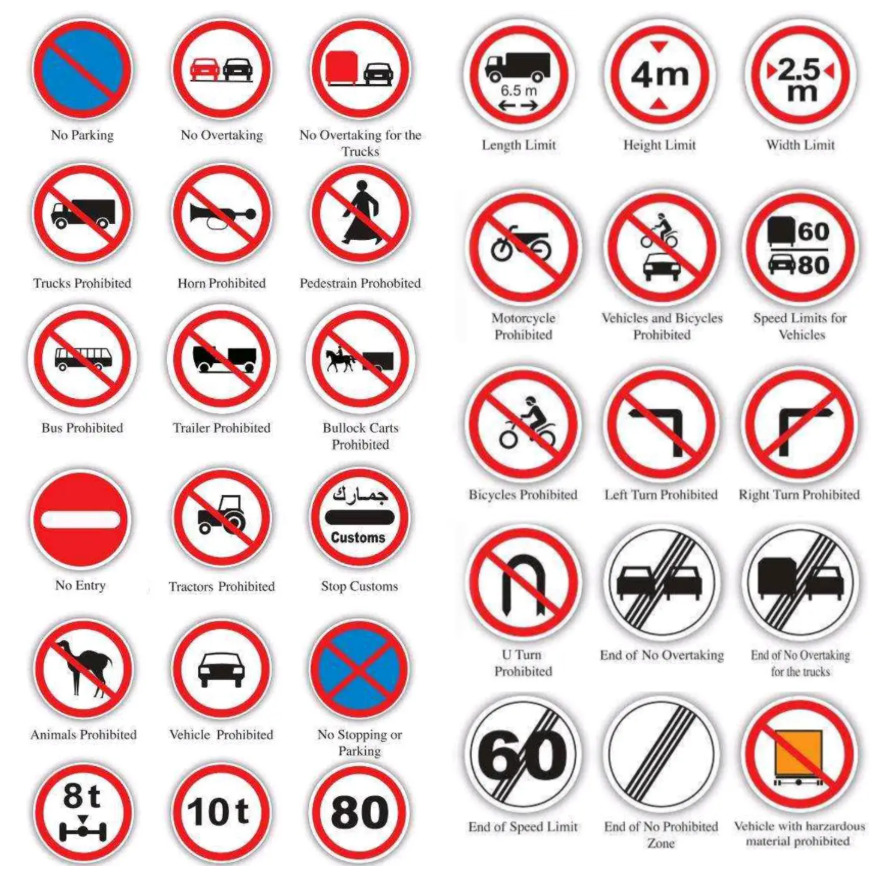
In Qatar, prohibition signs are circular with a red border and a white background, featuring a black symbol crossed by a red diagonal line to indicate forbidden actions. Common examples include No Entry, No U-Turn, No Horn, No Overtaking, No Parking, and restrictions for specific vehicles or pedestrians, such as No Motorcycles or No Tractors. Often accompanied by Arabic text, these signs play a vital role in regulating traffic, enforcing rules like speed limits, vehicle size restrictions (height, width, and axle load), and prohibited turns, helping ensure road safety and compliance with Qatari traffic laws.
- No Entry: A red circle with a white horizontal bar, indicating vehicles are not allowed from that direction.
- No Parking: A red circle with a blue background and a red diagonal line, prohibiting parking.
- No U-Turn / No Turns: A red circle with a white slash over a U-turn or arrow symbol, restricting turns.
- No Overtaking: A red circle with a white slash over two vehicle symbols, forbidding overtaking.
- No Horn: A red circle with a horn symbol crossed by a red line, indicating a no-honking zone.
- Speed Limit: A red circle displaying a number (e.g., 80 km/h) to indicate the maximum speed allowed.
- Vehicle Restrictions: Signs showing specific vehicles such as motorcycles, trucks, or tractors with a red slash, indicating they are prohibited.
- Pedestrians Prohibited Red circle with a pedestrian symbol and a red slash, forbidding pedestrian access.
- Size Limits: Circular signs with red borders indicating maximum height, width, length, or axle/load weight for vehicles.
Traffic Motion Control Signs in Qatar
In Qatar, traffic motion control signs encompass standard regulatory signs (such as Stop, Speed Limit, No Entry, and No Parking), warning signs (like curves, school zones, and roadwork), and directional guide signs, often displayed in both Arabic and English. In addition to these, unique traffic control methods such as police hand signals and whistles can override signs and traffic lights to manage traffic instantly, ensuring safe and efficient movement on busy urban streets and highways.
Unique Traffic Signs in Qatar
- Camel Crossing Alerts: In areas on the outskirts of Doha, drivers may spot camel crossing signs. These serve as important reminders to stay vigilant for camels wandering near the roads.
- Strict Speed Limit Enforcement: Motorists are expected to follow posted speed limits, which are clearly marked in kilometers per hour (kph), ensuring safe travel throughout the country.
- Bilingual Signage on Salwa Road: Traveling south on Salwa Road, drivers will notice signs displayed in both Arabic and English. This dual-language approach helps residents and visitors alike navigate with ease and clarity.
Traffic Light Signals in Qatar
- Red: Stop
A red light is a strict command to come to a complete stop at the designated line. Failing to stop can block cross-traffic and increase the risk of accidents. Running a red light is a serious traffic violation. - Green: Go
A green light signals that you have the right-of-way and can move through the intersection. Always proceed at a safe speed and remain alert to your surroundings. Avoid stopping in a way that obstructs vehicles behind you. - Yellow: Slow Down and Prepare to Stop
A yellow light warns that the signal is about to turn red. Drivers should reduce speed and be ready to stop. Ignoring a yellow light may be considered a traffic violation if it prevents yielding to cross-traffic.
Key Features of Qatar Traffic Signs
- Compliance with International Standards: Designed according to globally recognized traffic sign principles.
- Bilingual Presentation: Most signs display both English and Arabic for clear communication.
- Optimal Placement: Strategically positioned to ensure maximum visibility and road safety.
- Durable and Weather-Resistant: Engineered to withstand Qatar’s extreme climate conditions.
Qatar Traffic Signs Violations and Penalties
| Violation | Penalty (Fine) |
|---|---|
| Speeding | QR 500+ |
| Running a Red Light | QR 6,000 |
| Using Mobile Phone While Driving | QR 500 |
| Not Wearing Seatbelt | QR 500 |
| Damaging Traffic Signs | Up to QR 50,000 |
Black Points System in Qatar
- Drivers receive points on their license for traffic violations.
- Serious offenses (e.g., running red lights, DUI) carry higher points, such as 7 points.
- Minor violations carry fewer points.
- Accumulating points can lead to:
- License suspension (e.g., 14 points within a year).
- Permanent revocation for repeat offenders.
- Points remain on your record for one year from the date of the latest violation, not the first.
- The system aims to promote road safety and discourage dangerous driving.
Why Traffic Signs Are Tested
- Safety & Accident Prevention: The main objective is to reduce accidents by helping drivers respond correctly to hazards (warning signs) and follow traffic rules (regulatory signs).
- Traffic Flow Management: Signs such as “No Parking” or roundabout indicators help ensure smooth movement and prevent obstructions on the road.
- Legal Compliance: Knowing and understanding traffic signs is essential to obey the law and avoid fines or legal issues.
- International Standards: Qatar follows global traffic standards, so recognizing signs is important for both residents and expatriates.
- Comprehensive Knowledge: Theory tests evaluate understanding of regulatory, warning, mandatory, and guide signs, as well as road markings and signals.
Why Qatar Traffic Signs Are Important for Drivers
- Safety & Accident Prevention: Warn drivers of hidden hazards (pedestrians, slippery roads, speed cameras) and communicate rules (stop, yield, speed limits), reducing confusion and accidents.
- Traffic Flow & Efficiency: Directional signs and road markings guide drivers, easing congestion and promoting smoother journeys.
- Navigation & Wayfinding: Rectangular signs provide vital information on routes, services, and areas, helping drivers reach destinations even with GPS.
- Universal Language: Symbols and bilingual text (English/Arabic) overcome language barriers, benefiting both locals and tourists.
- Regulatory Compliance: Circular mandatory signs indicate required actions, ensuring drivers follow rules like speed limits.
- Environmental Resilience: Regular cleaning of signs is necessary in Qatar’s dusty climate to maintain visibility and allow quick driver responses.
Tips for Traffic Signs in Qatar
- Repetition: Review signs daily until recognizing them becomes automatic.
- Group by Category: Study signs in sets, such as regulatory, warning, informational, and temporary signs.
- Use Flashcards: Create cards with the sign on one side and its meaning on the other for quick practice.
- Associate with Real Situations: Connect each sign to actual driving scenarios, like slowing down near schools or avoiding no-entry roads.
- Roundabouts: Slow down, yield to traffic from the right, and watch for pedestrians and cyclists.
- Overtaking: Dashed white line = overtaking allowed.
- Solid white line = overtake only when necessary, with caution.
- Double solid yellow = no overtaking.
- Speed Limits: Always follow posted speed limits (in kph).
- Lane Discipline:
- Left lane generally for faster traffic.
- Right lane for slower vehicles, trucks, and entering/exiting traffic.
- Pedestrians: Yield at crossings; flashing yellow lights indicate heightened alertness.
- Unique Signs: Be aware of camel crossing signs in outskirts and rural areas.
FAQs About Qatar Traffic Signs And Their Meanings
What are the 4 types of traffic signs?
Road signs are generally classified into four main types: regulatory, warning, guide, and information signs. Some signs indicate prohibitions or mandatory actions, while others provide warnings, driving directions, or guidance to specific locations.
What is the vehicle prohibited sign in Qatar?
A circular sign featuring a black car icon with a red border. Commonly placed in pedestrian-only areas or construction zones, it indicates that motor vehicles are not allowed beyond this point.
What does a flashing yellow light mean in Qatar?
Flashing Yellow Light (Pedestrian/School): A flashing yellow light at pedestrian crossings or near schools alerts drivers to the presence of pedestrians. Drivers must slow down, exercise caution, and yield as needed.
What happens if you accidentally cross a red light in Qatar?
Violating traffic signals can lead to a fine of up to QR 6,000 and 7 demerit points on the driver’s license, emphasizing the importance of following traffic rules for road safety.
Can you turn right on red in Qatar?
Generally, turning right on a red traffic light in Doha is not allowed; drivers must wait for a green signal. However, there are exceptions: you may turn right if there is a dedicated right-turn lane or a green arrow signal. Additionally, some intersections have a “Right Turn Free” sign or lane, which allows drivers to turn right after yielding to pedestrians and oncoming traffic.
Conclusion
Qatar’s traffic signs are essential for safe, efficient, and organized road travel. By clearly communicating rules, warnings, and directions in Arabic and English, they minimize accidents, regulate traffic flow, and support responsible driving, ensuring a secure experience for all road users.