
Qatar Visa on Arrival For a Baby Born Outside Qatar. For many expatriate families, welcoming a newborn outside Qatar raises important questions about travel and residency. Many expatriate women living in Qatar choose to return to their home countries for childbirth so they can be supported by extended family. When they return, Qatar offers free visas on arrival for newborn babies, provided the child enters Qatar within a few months of birth. This visa is issued to newborn babies under six months of age when the child enters Qatar through an official port of entry accompanied by one or both parents. Qatar offers a practical solution through a visa on arrival for babies born abroad, allowing parents to reunite their families smoothly while meeting the country’s immigration requirements.
What is the Qatar Visa on Arrival for a Baby Born Outside Qatar?
A Qatar Visa on Arrival for a Baby Born Outside Qatar is a special immigration provision that allows newborns born outside Qatar to resident parents to legally enter the country without obtaining a prior visa. It is designed to help expatriate families reunite with their newborns and ensure the child can stay in Qatar legally.
Terms & Conditions for Qatar Visa on Arrival For a Baby Outside Qatar
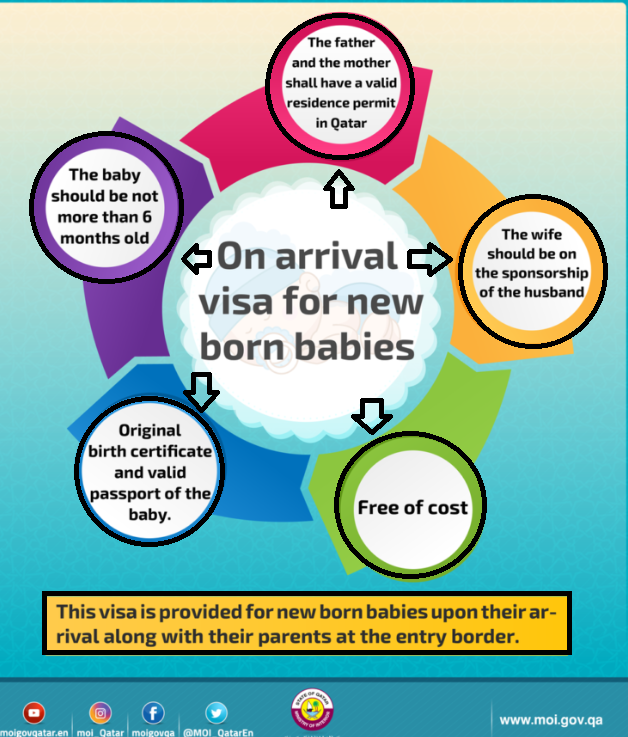
- At least one parent must be a resident of the State of Qatar with a valid residence permit.
- One parent should be sponsored under the other’s residency.
- The child must be under six months of age.
- The baby must have a separate passport.
- The original birth certificate of the child must be presented.
- Newborn Visa for babies under 2 months Babies entering Qatar before two months of age are issued a Newborn Visa, which can be directly converted into a Residence Permit (QID), making the application process straightforward for parents.
- Visa on Arrival for babies between 2 and 6 months Babies older than two months but younger than six months receive a visa on arrival, typically valid for 30 or 60 days.
Requirements for Qatar Visa on Arrival For a Baby Outside Qatar
- Valid Residence Permits for both parents: Both father and mother must hold valid Residence Permits in Qatar.
- The baby must be under six months old: if the baby cannot enter Qatar before six months, a Family Residence Permit must be applied for.
- Wife under husband’s sponsorship: The mother should be sponsored under the father’s residency; company-sponsored parents are not eligible.
- Original birth certificate and valid passport for the baby: The baby must have an original birth certificate and a valid passport; copies are generally not accepted.
- The baby’s parents must not have been outside Qatar for more than six months; otherwise, a return permit will be required.
How to Get Qatar Visa on Arrival For a Baby Born Outside Qatar
Follow these steps for a Qatar Visa on Arrival for a baby born outside Qatar.
Step 1: Ensure Eligibility
- The baby must be under 6 months old.
- At least one parent must be a Qatar resident with a valid Residence Permit (RP).
- The mother should be sponsored under the father’s RP.
- Parents must not have been outside Qatar for more than 6 months.
Step 2: Prepare Required Documents
- Baby’s original birth certificate (attested, if possible).
- Baby’s valid passport from the home country.
- Parents’ passports.
- Parents’ valid Qatar Residence Permits.
Step 3: Travel to Qatar
- The baby must enter Qatar accompanied by one or both parents through an official port of entry.
Step 4: Visa Issuance at Arrival
- Newborn Visa: For babies under 2 months; can be directly converted to a Residence Permit (QID).
- Visa on Arrival: For babies between 2 and 6 months; valid for 30–60 days.
Step 5: Apply for Residence Permit (QID)
- After arrival, parents must apply for the baby’s Residence Permit using the Metrashapp:
- Open Metrash and select Issue Residence Permit.
- Submit the baby’s details and required documents.
- Complete any required payments.
- Once approved, the baby will receive a Qatar ID (QID).
- The visa on arrival is a temporary visa, with its validity set by the immigration authorities at the airport, typically lasting around two months.
Cost of Qatar Visa on Arrival For a Baby Born Outside Qatar
- The visa is issued free of charge for newborn babies upon arrival in Qatar with their parents.
- It’s important to note that if the mother has been outside Qatar for more than six months, it is considered an overstay, and a return permit will be required for her to re-enter the country.
Penalty For Newborn Baby in Qatar
In Qatar, a fine of QR 10 per day is imposed if a newborn’s Residence Permit (RP) is not applied for within 60 days of birth. This penalty applies for missing the registration deadline, so it is essential to process the baby’s passport and RP promptly to avoid accumulating fines and potential legal complications.
FAQs About Qatar Visa on Arrival For a Baby Born Outside Qatar
How long can a newborn stay in Qatar without a visa?
According to Qatar’s immigration regulations, expatriate parents must apply for their baby’s residence visa within a specific timeframe. For babies born in Qatar, the application should be submitted within two months of birth. For babies born outside Qatar, the application must be made within two months of the baby’s arrival in the country.
Is a Qatar visa available for newborn babies on arrival?
This visa is granted to newborn babies who are under three months old at the time of arrival. There are no fees for the visa itself; however, a charge of QR 200 per day may apply. To be eligible, the baby must meet the following conditions: (1) be less than three months old, and (2) either have their own passport or be included in one of the parent’s passports.
Can babies born outside Qatar obtain a visa on arrival?
Yes, babies under six months of age are eligible for a visa on arrival, provided both parents hold valid Qatar Residence Permits.
Conclusion
Qatar’s visa on arrival for babies born abroad ensures seamless family reunification, offering a straightforward, cost-free entry process. By meeting eligibility and documentation requirements, expatriate parents can legally secure their newborn’s residence, avoiding fines and supporting smooth integration.