

In today’s increasingly digital world, cybercrime has become a serious and growing concern. From individuals to businesses, everyone can be affected, making it vital to know how and where to report such incidents to get timely support and help prevent further harm.
In Qatar, there are clear procedures and official channels for reporting cybercrime. These systems are designed to handle complaints efficiently and ensure proper investigation. This guide explains how to report cybercrime in Qatar in 2024, helping you understand the process and take the right steps with confidence.
What is Cyber Crime?
Cybercrime refers to unlawful activities conducted in the digital space using computers, networks, and the internet. It includes a wide range of harmful actions carried out by individuals or organized groups with the intention of causing damage, theft, or disruption.
Common forms of cybercrime include hacking, identity theft, online fraud, phishing scams, spreading malware or viruses, and gaining unauthorized access to computer systems or data.
Much like traditional crimes in the physical world, cybercrime aims to exploit victims—but instead of breaking into buildings, criminals target digital systems and online information. These illegal acts can have serious consequences for individuals, businesses, and even national security. Therefore, maintaining strong cybersecurity practices is essential, and government authorities play a crucial role in preventing, investigating, and stopping cybercrime.
QCB Campaign on Information Security
The Qatar Central Bank has launched a nationwide awareness campaign to strengthen information security. In partnership with the Ministry of Interior (MOI), the National Cyber Security Agency (NCSA), and the Qatar Financial Centre Regulatory Authority (QFCRA), the initiative aims to educate the public about common cyber risks and provide practical tips to stay protected. Key recommendations include:
- Never disclose personal or financial information over the phone.
- Do not answer calls from unknown international numbers.
- Stay cautious of unfamiliar local callers as well.
- If a call seems suspicious, immediately contact the organization being impersonated to verify it.
- If your bank card is lost or stolen, report it and block the card through official channels without delay.
Skimming devices are secretly placed on ATMs and point-of-sale machines to capture card details and record PINs, often resulting in financial fraud. To stay protected, follow these precautionary measures:
- Use ATMs located inside bank branches whenever possible.
- Before inserting your card, check that the card reader isn’t loose or tampered with.
- Carefully inspect the card slot and surrounding area for anything unusual.
- Always cover the keypad with your hand while entering your PIN.
- Stay alert and avoid using ATMs if suspicious people are loitering nearby.
How to Report Cybercrime in Qatar
Cyber blackmail and other forms of cybercrime are becoming increasingly common in Qatar. If you become a victim, it’s crucial to act quickly and follow the right steps to safeguard yourself and get the proper support.
Below is a clear, step-by-step guide designed specifically for reporting and dealing with cyber blackmail or cybercrime in Qatar:
Stay Calm and Evaluate the Situation
- Don’t Panic: Keep your composure so you can think clearly and make informed decisions. Take a moment to calmly assess the situation and understand the type and seriousness of the threat.
- Collect Evidence: Secure all relevant proof connected to the incident. This may include screenshots of messages, emails, call logs, or any other communication received from the offender.
Avoid Engaging with the Perpetrator
- Do Not Respond: Refrain from replying to or negotiating with the blackmailer or cybercriminal. Any response can embolden them and escalate the harassment.
- Do Not Pay: Paying a ransom offers no assurance that the threats will stop and often invites further extortion.
Document Everything
- Preserve All Communications: Maintain a complete record of every interaction with the perpetrator. These records can be vital evidence during investigations.
- Back Up Critical Data: Securely store backups of all important files to prevent data loss or tampering.
Report a Cybercrime Incident in Qatar
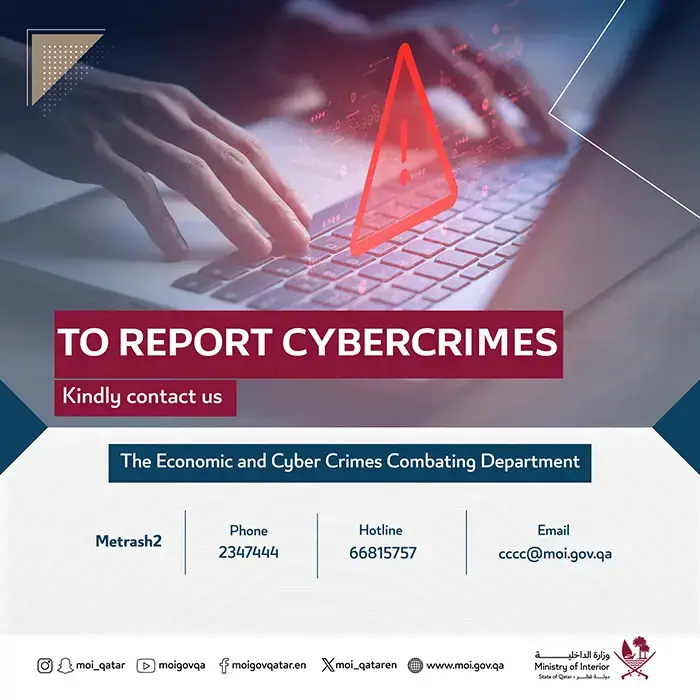
- Contact Local Authorities: If you encounter a cybercrime, report it immediately to the Economic and Cyber Crimes Combating Department (ECCD) in Qatar. You can reach them through the following channels:
- Phone: Call 2347444 for urgent assistance.
- Hotline: Use the dedicated hotline at 66815757.
- Metrash2 App: If you have the Metrash2 app, you can file your report directly through the app.
- Email: Send a detailed report to [email protected].
- Provide Detailed Information: Include all relevant details and evidence related to the incident. Accurate and comprehensive information will assist authorities in conducting a faster and more effective investigation.
Protect Your Digital Identity
- Update Your Passwords: Change passwords for all your accounts, prioritizing those affected by the incident. Use strong, unique passwords for each account.
- Activate Two-Factor Authentication (2FA): Enable 2FA wherever available to add an extra layer of security.
- Keep Security Software Current: Make sure your antivirus and anti-malware programs are up to date to defend against potential threats.
Seek Support
- Mental Health Assistance: If the incident causes stress or anxiety, reach out to a mental health professional or counselor for guidance and support.
- Notify Trusted Contacts: Inform friends, family, or colleagues if necessary, particularly if they could also be affected or targeted.
Follow Up
- Maintain Communication with Authorities: Stay connected with the Economic and Cyber Crimes Combating Department to receive updates on your case.
- Monitor Your Accounts: Regularly check your financial accounts and personal information for any unexpected or suspicious activity.
Prompt and effective action against cyber blackmail or cybercrime is essential to protect yourself and reduce potential harm. In Qatar, you can rely on the resources offered by the Economic and Cyber Crimes Combating Department, strengthen your digital security, and seek professional support to handle such situations efficiently.
Always remember that proactive measures and reporting incidents to the appropriate authorities are key in combating cybercrime. Stay alert, informed, and take steps to safeguard both your digital and personal well-being.
Information & Evidence Needed to Report Cybercrime
- Incident Details:
- Describe what happened, when it occurred, and how it happened.
- Specify the type of fraud (e.g., phishing, ransomware, identity theft).
- Digital Evidence:
- Screenshots of suspicious messages, fake invoices, or social media posts.
- Emails, chat logs, and other communication records.
- Log files and IP addresses linked to the incident.
- Transaction records such as credit card statements, money orders, or canceled checks.
- Any relevant digital files, including ransomware notes.
- Your Information:
- Full name and contact details (email and phone number).
- Identification documents to assist in tracking the case.
- Perpetrator Information:
- Any known usernames, email addresses, wallet addresses, or phone numbers associated with the fraud.
How to Report Online Fraud & Scams in Qatar
- Ministry of Interior (MOI) – Cybercrime
- Hotline: 6681 5757 or 2347 444
- Metrash2 App: Submit reports directly via the app
- Email: [email protected]
(Cyber Crime Combating Centre) - Online Portal: Report through the MOI eCrime portal
- Qatar Central Bank (QCB): For banking or financial institution-related issues
- Communications Regulatory Authority (CRA): For scams involving websites, apps, or telecom services
- Consumer Protection Department (MOCI): For frauds related to goods or services
The cybercrime prevention law in Qatar
On September 16, 2014, the Qatari government enacted Law No. 14 of 2014 to combat online and cyber crimes, aiming to strengthen measures against digital offenses. The law came into immediate effect, introducing strict penalties for various cyber activities. Key provisions of the law include:
Forgery Penalties:
- Forging official electronic documents can result in up to 10 years in prison and a fine of QR 200,000.
- Forging unofficial documents carries a prison term of up to 3 years or a fine of QR 100,000.
Impersonation and Identity Theft:
- Individuals involved in identity theft, impersonation, or theft of movable property online face similar punishments, ensuring a combination of imprisonment and fines.
Content-Related Crimes:
- Publishing false news or misleading content online is prohibited under the law.
- Since the law does not precisely define “false news,” journalists, news agencies, and social media users must exercise caution to avoid legal violations.
Unauthorized Use of E-Cards:
- Activities like stealing, forging, or unauthorized possession of e-cards, including ATM or credit cards, can lead to up to 3 years in jail and fines reaching QR 200,000.
Intellectual Property Violations:
- Violating intellectual property rights online including copyrights, patents, trademarks, trade secrets, trade names, industrial designs, geographical indications, or integrated circuit designs carries penalties of up to 3 years imprisonment and fines of QR 500,000.
Insult and Libel Online:
- Under Article 8 of Law No. 14 of 2014, anyone committing a cybercrime of insult or libel may face up to 3 years in prison, a fine of up to QR 100,000, or both.
This legislation highlights Qatar’s commitment to ensuring cybersecurity and digital accountability, emphasizing careful online conduct for individuals and organizations.
Importance of Reporting Cyber Crimes in Qatar
As cyberattacks grow increasingly sophisticated and pervasive, reporting these incidents has become more vital than ever. Timely reporting enables individuals, organizations, and government authorities to collaborate effectively, safeguarding Qatar’s digital ecosystem.
- Protecting Individuals and Organizations: Prompt reporting of cybercrimes empowers both individuals and businesses to take proactive measures against potential threats and financial losses. Unreported attacks allow cybercriminals to operate undetected, causing further harm. By reporting incidents, law enforcement can investigate, apprehend offenders, and prevent future attacks, ensuring justice and stronger protection for the community.
- Strengthening Cybersecurity Measures: Collecting detailed information on cybercrime trends allows the Qatari government to design robust cybersecurity strategies and policies. Analyzing reported incidents helps identify new threats, vulnerabilities, and attack patterns, enabling authorities to implement preventive measures and allocate resources more effectively.
- Raising Public Awareness and Education: Reporting cybercrimes promotes a culture of cybersecurity awareness across Qatar. Sharing knowledge about cyber threats helps individuals and organizations understand common attack tactics, enhance their digital defenses, and remain vigilant in protecting sensitive data and digital assets.
Types of Cyber Crime in Qatar
The surge of cybercrime in Qatar reflects a global trend, driven by the nation’s increasing dependence on digital technologies. While technological advancement offers convenience and connectivity, it also creates new avenues for criminals to exploit vulnerabilities.
Understanding the different types of cybercrime is crucial for developing effective measures to protect digital assets. Staying informed and vigilant is key to safeguarding both personal information and online activities from cyber threats.
Common Types of Cybercrime and Their Impact
- Online Fraud:
This broad category includes scams such as phishing attacks, fake online stores, and deceptive investment schemes. These tactics trick individuals into sharing personal information or transferring money to cybercriminals. - Identity Theft:
Cybercriminals may steal personal information, including names, addresses, Social Security numbers, or credit card details. Such data can then be used to carry out unauthorized transactions or fraudulent activities. - Malware:
Malicious software is designed to damage or infiltrate computer systems and networks. Malware often spreads through email attachments, infected websites, or removable devices like USB drives. - Phishing:
A specialized form of online fraud, phishing involves emails or websites that mimic trusted organizations such as banks to deceive users into revealing sensitive information. - Cyberbullying:
Cyberbullying uses electronic communication to harass, intimidate, or humiliate individuals, resulting in significant emotional and psychological distress. - Cyber Blackmail:
This occurs when criminals threaten to expose private information unless demands are met, often including financial extortion, adding a coercive dimension to cybercrime.
By recognizing these threats and adopting proactive security measures, individuals and organizations in Qatar can better protect themselves against the growing risks of the digital world.
To report Cyber Crime online in Qatar through the Metrash2 app:
Reporting cyber crimes in Qatar helps maintain a safe and secure online environment. Follow these steps to file a cybercrime complaint through the Metrash2 app:
- Log in to Metrash2 App
Ensure the Metrash2 app is installed on your mobile device. Open the app and log in using your Qatar ID (QID) and personal PIN. If you haven’t registered, follow the app’s registration process to create an account. - Go to “Communicate with Us”
After logging in, navigate to the “Communicate with Us” section, which allows communication with government authorities, including the Security Department. - Select “Criminal Complaint (Security Department)”
Within this section, click on “Criminal Complaint (Security Department)” to begin reporting your cybercrime. - Choose Department and Attach Complaint Photo
Select the appropriate department for cybercrime reports. Attach a photo of your written and signed complaint, ensuring the text is clear and readable. - Select Complaint Type
Choose the complaint type that best describes the cybercrime you are reporting. Options may include specific categories for online offences. - Provide Location and Brief Details
Enter the location of the incident and provide a short description. Include relevant details to help authorities understand the context and severity of the cybercrime. - Add Phone Number (if needed)
If your phone number is not already linked to your account, enter it so authorities can contact you for updates or further information. - Submit Your Complaint
Review the information and click “Send” to submit your cybercrime report. The authorities will receive your complaint for investigation.
Important Tips to Stay Safe from Cybercrime in Qatar
- Enhance Access Security: Use strong, unique passwords and enable Two-Factor (2FA) or Multi-Factor Authentication (MFA) wherever possible.
- Keep Systems Updated: Regularly update your operating system, apps, and antivirus software to fix vulnerabilities.
- Stay Alert to Phishing: Avoid clicking suspicious links or opening attachments from unknown sources; always verify the sender.
- Secure Your Network: Refrain from sensitive transactions on public Wi-Fi; use a VPN when necessary.
- Monitor Your Accounts: Frequently review bank statements and online accounts for unauthorized activity and report issues immediately.
- Protect Personal Information: Be careful when sharing sensitive data such as passwords or banking details online.
Common Mistakes to Avoid When Reporting Cybercrime
When reporting cybercrime, it is crucial to avoid errors such as delaying the report, failing to document all details thoroughly (including screenshots, logs, and timestamps), sharing unverified information, mishandling evidence (like wiping or continuing to use devices), neglecting to secure digital footprints (such as weak passwords), and overlooking employee training. These mistakes can impede investigations, waste valuable time, and exacerbate the damage. Effective reporting, by contrast, requires providing detailed, factual accounts and ensuring evidence is preserved from the outset.
FAQS About Report Cybercrime in Qatar
What is the official process to report cybercrime in Qatar?
In Qatar, cybercrime can be reported through the Economic and Cyber Crimes Combating Department (ECCD). You can submit complaints via phone (2347444), hotline (66815757), email ([email protected]) or the Metrash2 app. Make sure to provide detailed information and evidence to help authorities investigate effectively.
What types of cybercrime are common in Qatar?
Common cybercrimes in Qatar include online fraud, identity theft, phishing scams, malware attacks, cyberbullying, and cyber blackmail. Being aware of these threats helps individuals and businesses take proactive steps to protect themselves.
What evidence should I collect before reporting a cybercrime?
Collect screenshots of messages or emails, chat logs, transaction records, IP addresses, and any other digital evidence. Keep detailed records of the incident, including the date, time, type of crime, and any contact with the perpetrator. This evidence is crucial for a successful investigation.
Can I report cybercrime online in Qatar?
Yes. Qatar residents can report cybercrime online through the Metrash2 app or the Ministry of Interior’s eCrime portal. This allows you to submit detailed reports, attach evidence, and communicate directly with authorities for follow-ups.
What should I do to protect myself from cybercrime in Qatar?
Always use strong, unique passwords and enable two-factor authentication. Keep your devices and software updated, avoid clicking suspicious links, secure your network, and regularly monitor your accounts. Promptly reporting incidents and following security best practices reduces the risk of further harm.
Conclusion
Cybercrime poses significant risks in Qatar’s digital landscape, affecting individuals, businesses, and national security. Timely reporting through official channels like the Economic and Cyber Crimes Combating Department or the Metrash app is essential for effective investigation and prevention. By staying vigilant, safeguarding personal data, and following proper reporting procedures, residents can protect themselves, support law enforcement efforts, and contribute to a safer, more secure online environment.